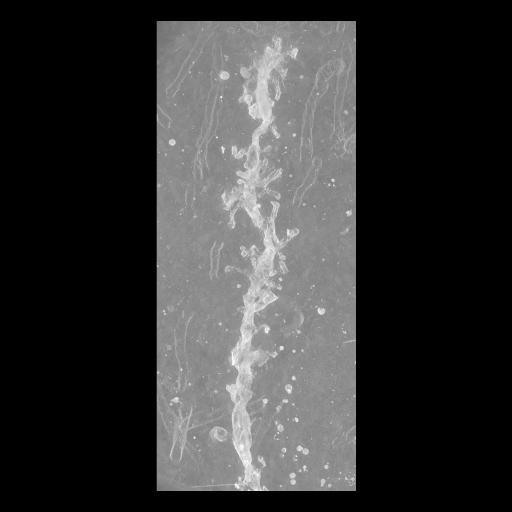
A spiny dendrite from neostriatum of a dopamine transporter knockout mouse. The cell was imaged using photoconverted Lucifer yellow, and a maximum intensity project image was created. This reconstructed image has been downsampled from the raw data image, which can be accessed using the link provided to the Cell Centered Database.
Mouse strain B6;129-/Slc6a3 tm2Mca was used in this preparation. Individual cells in fixed tissue were injected with Lucifer yellow and stored in 4% paraformaldehyde at 4° C. Fluorescence was photoconverted using DAB and a confocal laser light source. After this process, tissue was washed thoroughly in PBS and processed for EM by osmication, dehydration, and embedding in epoxy resin. For detailed methods, see the protocol provided in the CCDB. The tomogram was generated using an Hitachi UHVEM. Single tilt images spanned -60 to 60° in 2° increments. Magnification, 3000X; accelerating voltage, 3.0 MeV.
| Spatial Axis | Image Size | Pixel Size |
|---|---|---|
| X | 512px | —— |
| Y | 512px | —— |