Licensing
Attribution Non-Commercial Share Alike:This image is licensed under a Creative Commons Attribution, Non-Commercial Share Alike License. View License Deed | View Legal Code
Comments:
Powered by Pnyxe
Description
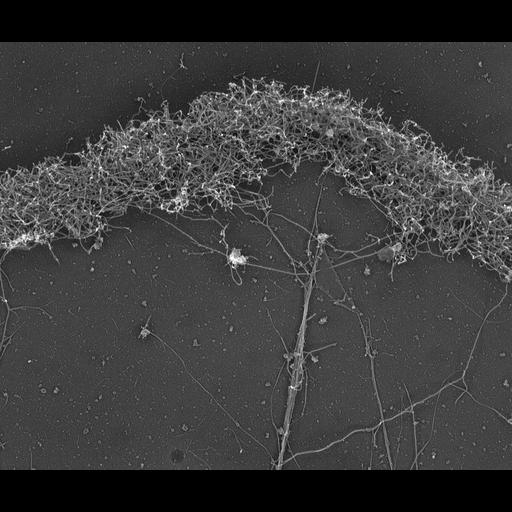
Structural differentiation of actin network in lamellipodium. Electron micrograph of Xenopus fibroblast after unprotected extraction without polyethelene glycol and phalloidin. Actin network at lamellipodial rear disassembled in the course of unprotected extraction, whereas front zone remained as dense as in control cells (CIL 24801). Image corresponds to Figure 6f from J Cell Biol. 1999 May 31;145(5):1009-26.
Technical Details
Procedures for detergent extraction, immunostaining, S1 decoration, light, and EM were described previously (Svitkina et al., 1995, 1996, 1997;Verkhovsky et al., 1995; Svitkina and Borisy, 1998).
Biological Sources
- NCBI Organism Classification
- Xenopus laevis
- (African clawed frog)
- Cell Type
- fibroblast
- Cellular Component
- lamellipodium
- actin cytoskeleton
Biological Context
- Biological Process
- cellular localization
- actin filament-based process
- Molecular Function
- structural constituent of cytoskeleton
Attribution
- Names
- Tatyana M. Svitkina
- Gary G. Borisy
- Published
- J Cell Biol. 1999 May 31;145(5):1009-26.
- Pubmed
- 10352018
Grouping
This image is part of a group.Imaging
- Image Type
- recorded image
- Imaging Mode
- transmission electron microscopy (TEM)
- Parameters Imaged
- optical path length gradient
- Source of Contrast
- differences in deposition of metal shadow
- Visualization Methods
- shadowing and plating
- platinum replica
- Processing History
- unprocessed raw data
Sample Preparation
- Methods
- permeabilized tissue
- glutaraldehyde fixed tissue
- Relation To Intact Cell
- dispersed cell in vitro
Dimensions
| Spatial Axis | Image Size | Pixel Size |
|---|---|---|
| X | 3972px | —— |
| Y | 3327px | —— |

*CIL – Cell Image Library accession number. Please use this to reference an image.