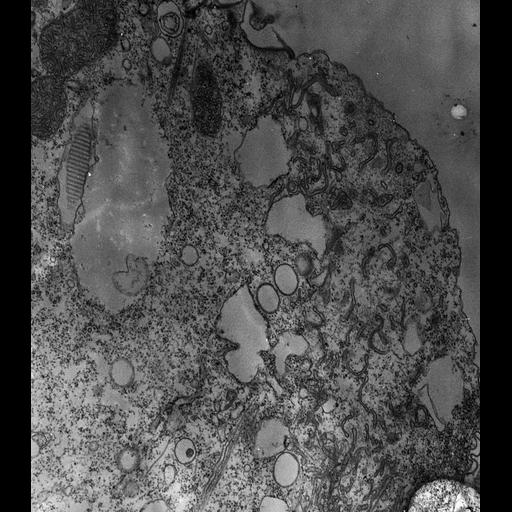
High resolution image of a colchicine-treated cell, used in an attempt to disrupt its microtubules. We found that microtubules already formed are not disrupted in Paramecium multimicronucleatum. This open cytoproct shows the microfilaments around the retrieved membrane vesicles. The larger vesicles appear to be expanded ER as ribosomes can be seen on their cytosolic face. A long membrane tubule appears to be bound to a microtubular ribbon that may have its origin at the cytopharynx. TEM taken on 1/16/73 by R. Allen with Hitachi HU11A operating at 60kV. Neg. 8,100X.
The raw film was scanned with an Epson Perfection V750 Pro. This image is best used for quantitative analysis. Standard glutaraldehyde fixation followed by osmium tetroxide, dehydrated in alcohol and embedded in an epoxy resin. Microtome sections prepared at approximately 75nm thickness. Additional information available at (http://www5.pbrc.hawaii.edu/allen/).
| Spatial Axis | Image Size | Pixel Size |
|---|---|---|
| X | 4958px | 1.6nm |
| Y | 5646px | 1.6nm |