Licensing
Description
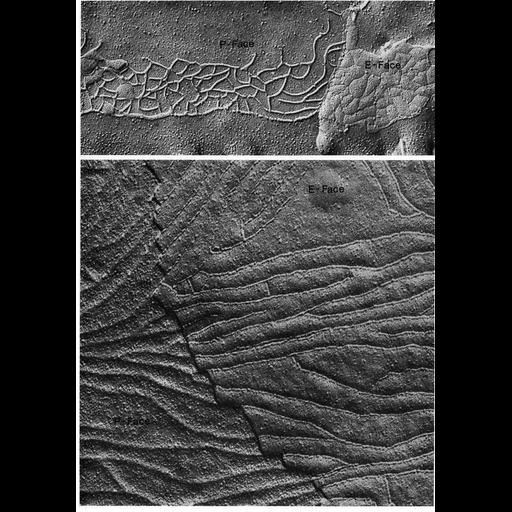
Upper panel shows a typical zonula occludens of rat intestinal epithelium, prepared using freeze fracture techniques. A network of intersecting strands on the P-face, and a complementary pattern of grooves on the E-face of this freeze fracture image. The lower panel includes a portion of a Sertoli junction from human testis consisting of a large number of parallel rows of complementary grooves of intramembranous particles which adhere preferentially to the E-face. Fig. 70 micrograph (upper) contributed by J.P. Revel; fig. 71 (lower) from Suzuki and Nagano, Cell Tissue Res. 166: 37 (1976), reprinted with permission in Chapter 3 (Junctional Specializations) of 'The Cell, 2nd Ed.' by Don W. Fawcett M.D. A PDF copy of the accompanying chapter is available on the ASCB's BioEDUCATE website.
Biological Sources
- NCBI Organism Classification
- Rattus
- (Old World rats)
- Homo sapiens
- (human)
- Cell Type
- intestinal epithelial cell
- Sertoli cell
- Cellular Component
- occluding junction
Biological Context
- Biological Process
- cell-cell junction organization
Attribution
- Names
- Jean Paul Revel
- Fumi Suzuki
- Toichiro Nagano
- Published
- ISBN 0721635849
- Link
- The Cell, 2nd Ed. by D.W. Fawcett
- Pubmed
- 1248038
Grouping
This image is part of a group.Imaging
- Image Type
- transmission electron microscopy (TEM)
- Imaging Mode
- illumination by electrons
- detection of electrons
- Parameters Imaged
- electron density
- Source of Contrast
- differences in deposition of metal shadow
- Visualization Methods
- shadowing and plating
- Data Qualifiers
- processed data
Sample Preparation
- Methods
- freeze_fracture/freeze_etch
- Relation To Intact Cell
- isolated subcellular component
Dimensions
| Spatial Axis | Image Size | Pixel Size |
|---|---|---|
| X | 891px | —— |
| Y | 1272px | —— |